What if a forgotten corner of a city park could become a dense, biodiverse woodland - planted in a single day, and cared for by the same children who put the first trees in the ground?
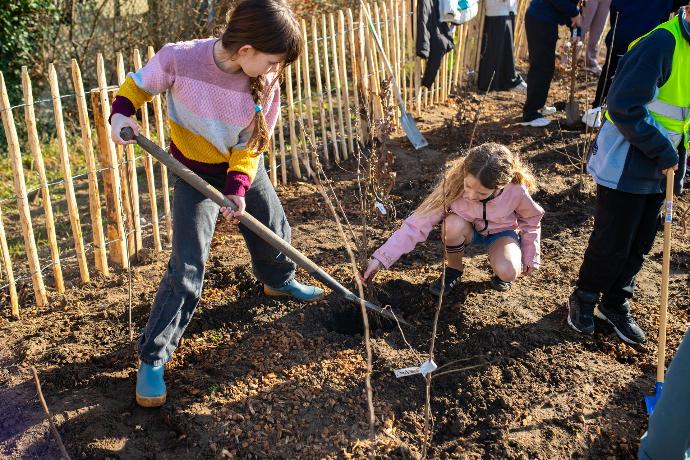
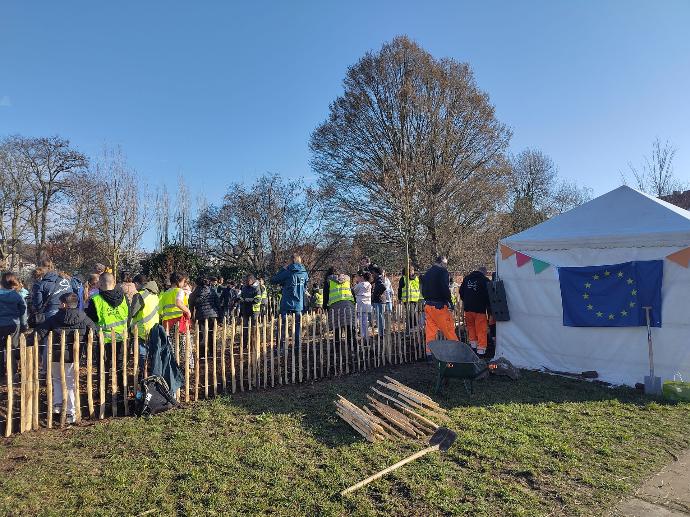
That’s exactly what happened in Caputsteenpark in Mechelen, where the City of Mechelen and GoodPlanet Belgium joined forces with over 300 pupils from local schools and nearby residents to plant a Tiny Forest® of 625 native trees and shrubs. In just a few hours, a former dog park became a compact, fast-growing patch of woodland, designed to cool the city, boost biodiversity and make the neighbourhood more climate-resilient.
The initiative was delivered as part of the GreenDense project and demonstrates one of its core principles: even small public spaces can deliver outsized ecological and social value when greening efforts are well designed, well supported and rooted in community stewardship.
Turning planting into participation
Pupils from Lyceum Mechelen and Busleyden Atheneum Caputsteen planted the forest alongside local neighbours, guided by GoodPlanet Belgium — the national ambassador for Tiny Forests. Beyond organising the preparation, planting day and long-term management, GoodPlanet also transformed the site into a learning environment, offering workshops, materials and tools, and creating a pathway for pupils to become official “Tiny Forest Rangers.”
As Jo Van Cauwenberge, director of GoodPlanet Belgium, put it:
“A Tiny Forest is unique because it combines nature with education and community participation. Thanks to the specific planting method, it will quickly grow into a valuable green space where everyone is welcome.”
For Mechelen, the Tiny Forest is more than a greening intervention; it’s an investment in residents’ quality of life. As Patrick Princen, Mechelen’s Alderman for Biodiversity, explained. As Mechelen’s Alderman for Biodiversity, Patrick Princen, highlighted:
“A Tiny Forest brings nature closer to people and boosts biodiversity in urban areas. High-quality green space near where people live is essential for health and wellbeing, and these small pockets of wilderness make the city more climate-resilient.”
Why working with schools matters
Bringing schoolchildren into the process turns the Tiny Forest into more than a one-off event. It becomes a living classroom - a place where pupils can learn about ecosystems, biodiversity and climate resilience in an environment they helped create. Planting the forest gives them a shared sense of ownership and pride, and nurtures long-term environmental awareness, both among pupils who will grow up alongside “their” forest and the wider community who will visit and help care for the space.
Key learnings for future Tiny Forests, in Mechelen and beyond
The Caputsteenpark Tiny Forest underlined the value of practical collaboration across schools, neighbours and municipal teams. Several clear learnings stood out:
- Hands-on engagement works: children were highly motivated when learning happened through doing - planting, observing, and discovering native species.
- Choose a site with social value: visible, well-used locations (including overlooked spaces within parks) help ensure the forest becomes part of everyday urban life.
- Give children a role with pride attached: labels like “Tiny Forest Rangers” make stewardship tangible and encourage long-term care.
- Municipal teamwork is essential: behind one successful planting day is a lot of preparation - and Mechelen benefited from strong internal cooperation across teams including nature & greenery, maintenance & cleanliness, and marketing & communication.
Mechelen’s Tiny Forest is a vivid example of the GreenDense project in action, delivering on each of its core aims: making cities more resilient to climate pressures while supporting broader policy agendas around public health, active mobility and youth engagement. We can’t wait to see Mechelen’s Tiny Forest grow, flourish, and inspire similar initiatives across Belgium and beyond.